Byron Katie – Closed heart, closed mind…
Liberation
“Our real nature is mukti (liberation). But we are imagining we are bound and are making various, stenuous attempts to become free. This will be understood only when we reach that stage. We will be surprised that we were frantically trying to attain something which we have always been and are.”
– Ramana Maharshi

“We don’t judge here”
James Wood:
“People often say “Don’t judge.” You get in certain quasi-spiritual circles — and actually this happened to me when I was nineteen. I was at this workshop and I was very new to all this stuff. I said something about “higher consciousness,” and a woman who had a lot more experience with this kind of thing said, “Oh, that’s judgmental. We don’t judge here. Nothing’s really higher than anything else.” All is one or whatever. And I didn’t know what to say because I was so new to the milieu.
But it struck me. It bothered me. I just kind of let it go, but it started a dialogue within me. I wondered about it. What does that mean? What is a judgment? Eventually it became clear to me that it’s important and necessary to describe our experience accurately and honestly. That’s what I would call a descriptive judgment. It’s not ultimately true, but it’s useful and it matches my experience. And without that, we’re really in trouble.
When people say “Don’t judge,” that’s what I call a value judgment. And that’s saying that something is wrong or bad, which is actually just saying that it shouldn’t be what it is.
It’s important to distinguish that. If someone said, “John and Fred had a footrace. Fred crossed the finish line first and won the race. John came in second place.” That’s not a judgment. That’s just a description of what happened. But if I said, “John is a loser,” like he’s not okay, something’s wrong with him, that’s a value judgment.
Or “John is taller than Fred.” Is it true? Well, you could measure them and find out. But if you said, “John is taller and therefore superior as a human being,” that’s horror. It’s the foundation of misery. It’s a value judgment.
It’s subtle, perhaps, but we’re doing it all the time. If you look at the media, it’s everywhere. So what I like to say is it’s not whether things are right or wrong, it’s about what works and what doesn’t.”
– James Wood, Ending Suffering
John de Ruiter on Skepticism and Doubt
From Skepticism and Doubt: A Misuse of Power, excerpt of a discussion with John de Ruiter
John: Skepticism and doubt is a misuse of power. You can always ground your self by breaking something. Anybody can break something. As soon as they break something, they’re grounded in themselves. Whereas for someone to go about not breaking anything, whatever they do, they’re only contributing or building something to do with goodness. That’s really extraordinary and it’s really difficult. It requires so much. It requires a lot of character.
If you’re going to be building something, you’ll be moving past your self. If you’re not given to building something and contributing to goodness, then you’ll ground your self and you’ll give your self meaning by having the power to take something down. So then you’ll bicker or complain or doubt or find fault, and then you always have your own ground and that always makes you higher than that which you’re speaking about. So you have your instant account of moving past your self, moving past someone else by just being higher than them and speaking down.
Q1: Feeling superior…
Q2: Is that a sophisticated way also of being safe? Not taking responsibility for what you know.
John: If you’re loyal to skepticism and doubt, you’re separate then from everything that you’re looking at, and within short order you are alone in the universe. People don’t view it that way because they don’t follow through the natural process that skepticism is. So it’s all worked out as actually having some kind of virtue.
Q1: Without carrying it through to its logical end.
John: People masquerade their skepticism with care. And they’ll even say “I’m concerned about this and that” and it’s not concern. It’s an escape from real knowledge and using concern to cover up the trail.
Q1: To pose as concerned.
John: And then use power and be comfortable in your self by even thinking that you’re doing something good.
Q2: If that’s a strong and heavy pattern, is there anything to be done actually with it? So that’s why in a way there’s not much value in actually dealing with the skepticism? It’s actually about coming from something deeper?
John: It’s about meeting someone instead of dealing with their skepticism. If you deal just with someone’s skepticism then you’ll be feeding into what they’re feeding into. If you’re not able to meet with someone then you’re not able to help them with their skepticism, because the bottom line with skepticism is it doesn’t want help.
Q2: That’s clear. But then if that pattern is rare, then rather than dealing with the pattern, it’s only about what you said at the beginning: giving your heart only to what you know.
John: Giving your heart only to what you actually know the truth of.
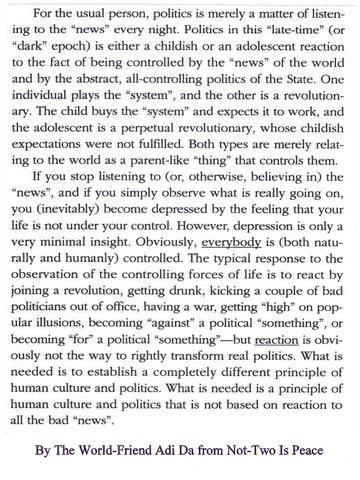
Adi Da on Politics
Radical acceptance
Excerpt from the talk Ending Suffering, by James Wood:
“Questioner: Would an awakened person get upset about poverty in their neighborhood and organize a food bank to make it better for the neighborhood or just let it be what it is?
James: Like social activism?
Q: Yeah, like you see a problem and you do something to make it better or just accept that it’s the way it is?
James: Well, you can radically accept it.
When I say “acceptance,” I don’t mean a superficial resignation. You accept the existence of social ills: poverty, hunger, disease, and so on. You can still do something about those things, but if you angrily say Poverty shouldn’t be happening! and then go out and start killing people you think are responsible — there’s always an enemy, and it doesn’t work.
But the enemy is the self. So you’re working on that, and if there’s a food bank in your neighborhood and if it’s part of the flow of your life and you feel drawn to it — sure, why not? But there will probably be less ego in it, right?
Let’s face it: There are people who do charity work in order to make themselves look more compassionate — which isn’t compassion at all.
The way I define compassion, which is really at the heart of this work, is an awareness of others’ suffering coupled with a willingness to do something about it. It’s a willingness. I mean, you can’t feed everyone. Right?
The thing is, I don’t hear you talking about actual things going on for you personally, so it’s a little bit abstract. To go deeper, it would have to be something that you’re facing.
But generally speaking, radical acceptance is not an impediment to that kind of activity, and you’ll probably be drawn to the ones that will actually do some good. And some don’t, or don’t do as much. And I think that’s part of it. That’s part of it.
So when you accept things as they are — the way I’m talking about it — you become acutely aware of suffering in the world — but less and less do you feel that suffering shouldn’t be happening — because suffering is caused by an attachment to the thought that what is shouldn’t be.”
Unreality
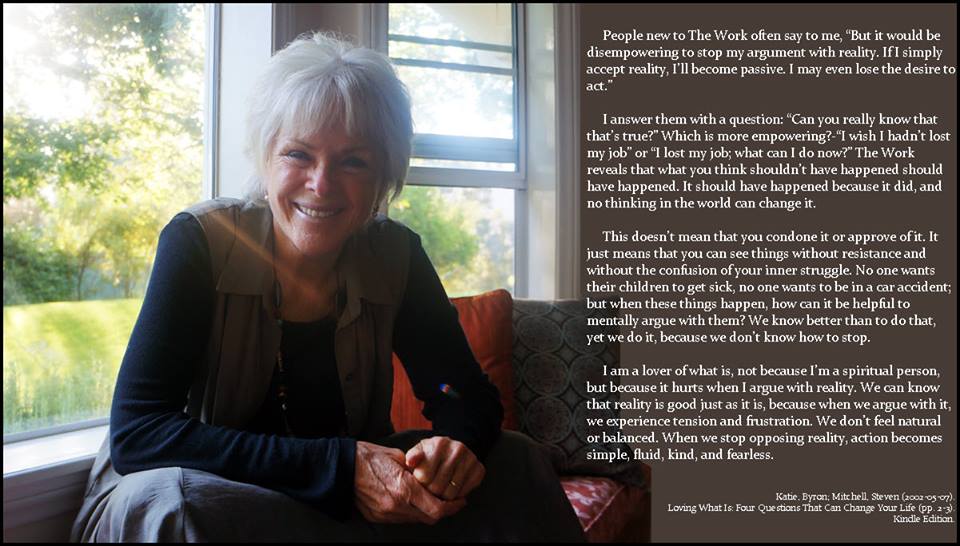
“The only thing you fear is the unreality that you yourself have invented.” ~ Byron Katie
Ending suffering
“What matters is where we’re stressed-out, tense, anxious, violent, and negative toward ourselves and others.
And at the root of all of that is an idea that disagrees with Reality, and that’s all it can be. Because if your ideas merge with Reality, it’s completely and utterly peaceful and functional.
The world is inherently imperfect. It has a certain sloppiness about it. And it’s natural, so it flows. It might not look like what we think it should look like — and that’s a good thing, because it never does.”
– James Wood, Ending Suffering

Compassion Q & A with James Wood
“Egotism is taking one’s thoughts so seriously that it becomes like a bubble that isolates you from others.”
James Wood, on Compassion
“We have a habit of judging things as wrong or bad, and this stresses us out…Nonjudgmental awareness helps to act compassionately.”
James Wood Teachings
Loving what is
The cause of war
“If you straighten yourself out, if you are no longer putting out hostility or deception, then you are putting out something that is helpful, therefore that is the only thing you can do to help society… Your anger is the cause of war.”
– Vernon Howard, The Esoteric Path to a New Life

Why Awakening?
“Compassion dictates that we relieve suffering. Who among us isn’t moved by daily news stories and images of misery across the globe?
But most of us probably feel that there’s not much we can do about it.
If I see an image of a starving child, an oppressive regime, or a grieving mother—what am I to do?
There is something you can do. You can work to eliminate your own suffering.
In fact, it’s the only way.”
– James Wood, Why Awakening?

True goodness
THE TRULY GOOD WOMAN
“A woman who felt guilty over past misdeeds said to herself,
‘I must repent. I will start by doing good to others.’
So she joined charitable organizations and said nice things
to people. But to her surprise she felt a vague resentment
toward her activities. She felt forced to be good. This
doubled her guilt, for now she felt guilty over her resent-
ment toward doing good.
Though confused, she intelligently reflected, ‘There is
something dreadfully wrong. This is not goodness at all;
it is self-enslaving stage-acting. True goodness must be
something entirely different.’
So she began a search for true goodness, which she finally
found. She explained to herself, ‘True goodness blooms in
the absence of an unconscious self-picture of being good.’
Abolish conditioned thoughts about personal goodness and
badness and authentic goodness flourishes.”
–Vernon Howard, Inspire Yourself, p. 45
You cannot deceive a True Teacher
THE SWAMP
“Fake religious teachers and false religious followers love each other…Each silently demands and gets soothing lies from the other, after which they all smilingly wander together down to the swamp. A sign of a truly unfolding spiritual life is to see through this devilish conspiracy. You cannot deceive a True Teacher. Be grateful for that.”
– Vernon Howard, SOLVED The Mystery of Life
Ending Suffering
“I think some ideas or notions have crept into Buddhist thinking that it’s going to take a long time to wake up. That’s not necessarily the case. I don’t recommend thinking that with any seriousness, any belief or attachment. I’m not a Buddhist per se, but what I’m here to represent is that awakening is possible for anyone who really wants it.
I think the “really wants it” is a big part. So I’m here to help. But in the meantime, you can have a better life, a more functional life.
When I work with people, if I’m doing a workshop, more formal than a talk, more intensive, I’ll make sure that people understand that this work is consecrated to awakening. As long as you understand that, you won’t think it’s a bait-and-switch where maybe you got into it for personal improvement, and somewhere along the line you realize that the self that you’re trying to improve is going to be gone.”
– James Wood, Ending Suffering
The practice of failure
“It took about five years of practice to wear down the seeker in me. I strove so hard that I was completely at the end of my rope. For five years I pushed myself until I literally thought I was going to have a major psychological breakdown. I would wake up thinking, Is this the day I end up in a mental ward? One day I went into my little meditation hut in the backyard, and I said to myself, I’m going to break through. Right here. Right now. I put all of my will into it, and within ten seconds it just imploded on me. I said, “I can’t do this.” The knowledge was from my gut. “I can’t do this.” It was like when someone punches you in the stomach and all the air goes out. I was totally deflated. That’s why I often tell people my practice was the practice of failure. I failed. I didn’t progress to a higher state. I beat my head against the wall until I failed. And even then I didn’t give up. I couldn’t be that noble.”
“It’s not the divine that must be found”
“It’s not the divine that must be found, it’s the things you’re deluding yourself with that must be released.”
“It’s not about being a fan of the Absolute.”
–Adi Da Samraj

“Humility is getting yourself out of the way”
“Humility is getting yourself out of the way, surrender, like a prostration, letting that Greater Power, Force, Truth, whatever — take you over, until there’s no you, there’s just it. And then it just is.
It strengthens, it endures, it’s powerful — but not over anything. It’s seeing the Divine. And it has its own way of doing things.
There’s no way that the intellect is going to understand that. As soon as the intellect says, “Oh, I’ve got this figured out,” it’s going to do something else.”
-James Wood, Importance of Body

Innocence
“In existence there is nobody who is superior and nobody who is inferior. The blade of grass and the great star are absolutely equal…. But man wants to be higher than others, he wants to conquer nature, hence he has to fight continuously. All complexity arises out of this fight. The innocent person is one who has renounced fighting; who is no longer interested in being higher, who is no longer interested in performing, in proving that he is someone special; who has become like a rose flower or like a dewdrop on the lotus leaf; who has become part of this infinity; who has melted, merged and become one with the ocean and is just a wave; who has no idea of the “I”. The disappearance of the ”I” is innocence.”
– Osho The White Lotus

Valuing your life
“Please understand this: When you value your position in life, when you value your life situations, that is not the same thing as valuing your life. Your varied conditions where you live, how you live, the large or small size of your bank account, the number of friends, acquaintances, activities all these are not your life.
They are happenings that are so numerous and so overwhelming and so demanding that unknown to yourself you have a conversation with yourself, and you carelessly without realizing what you are doing or saying, you tell yourself statements such as the following: ‘My life has had nothing but ill fortune; my life is bumpy; it’s going the wrong way; my life is not turning out the way I hoped it would; in spite of all my efforts, my life is just dull, boring, defeating, and sad.’
I want you to be far more careful with your vocabulary, with your use of words. You can give yourself a great shaft of light that will explain everything to you simply by knowing how you carelessly misuse words, terms, ideas. Now, you have just learned that what you do is not your life. So stop calling it your life. It’s an action. It’s a tragedy. It’s a misfortune. It’s a blow. It’s a sudden in-crease in your financial stature. It is not you. It is not your life.”
– from a talk given 12/28/1988 Vernon Howard’s Higher World
“The mind wants to tell you that you are something that needs to be held onto”
“It’s like your whole life you’re clinging to the side of a cliff, hanging over an abyss, and you’re afraid of falling, of letting go. Not only is there no way to know what that is when that letting go happens ― a complete letting go into awakening itself ― there is no way to know what in some sense awaits you. It awaits Itself. What you’re letting go is “you.”
But let me tell you: when you let go, it’s like you’re suspended about one nanometer above solid rock the entire time. And it’s even more solid ― less risky ― than that. But the mind wants to tell you that you are something that needs to be held onto. And when you let go, the sense of self, just like the politician, is still there, you’ve just voted him out of office. It’s no longer a problem.”
– James Wood, Sanity
Compassionate intervention
“Compassion will just reach in there and break whatever is possessing you. And if there’s an attachment to the pattern, it may be hard to grasp that it’s there to help you. It may seem like an enemy, and you will fight it. There’s a certain kind of force to the intervention, the way a surgeon might perform an emergency appendectomy with a spoon if necessary.”
– James Wood, Importance of Body

“Real meditation…is not a pious attempt to quiet your little thoughts”
“Meditation is not something that takes place in the dilemma. Real meditation is not a method to get rid of your suffering. It is not perpetual preoccupation with your own thoughts, the content of your life, in order to get free of them, to get aside from them, make them be quiet. The you who does all that is itself the dilemma. It knows nothing. It is itself the suffering. It is itself obsession with the endless stream of its own thoughts. Therefore, the attempts by such a one to do something about his “mind,” to make it quiet, to make it see visions, whatever, are within the form of this original motivating dilemma. Such strategies are expressions of his separate life, attempts to fortify and save his separate life, which is already an illusion.
Real meditation arises only in Satsang, only under conditions of Truth, already lived. There is force in such meditation. Real meditation is an intense fire. It is a marvelous intelligence, a brilliance, a genius, a living force. It is not a pious attempt to quiet your little thoughts. It blasts the hell out of these thoughts! From the point of view of the Self, the Truth, the Real, there is no concern for all these thoughts, all of these dilemmas, all of this mediocrity of suffering. It is nothing.
When Satsang lives as the principle of your life, and Truth becomes the form of your meditation, it consumes thought. It is a presence under which thoughts cannot survive. It is an intelligence that needs only to look at some obstruction for it to dissolve. This is the process that comes awake in Satsang, not some method, some remedy. The whole point of view of dis-ease is false. Spiritual life is not a cure. Spiritual life is the life of Truth, Satsang. One who is looking for a cure is obsessed with his disease.”
– Adi Da, The Method of the Siddhas
“Satsang literally means true or right relationship. It is commonly used to refer to the practice of spending time in the company of holy or wise persons” –The Method of the Siddhas
Compassion fuels practice
James Wood on compassion:
“How long do I practice before I wake up? It’s like digging to China. How do you know when you get to China? You see daylight, stick your head out, and there are Chinese people around.
Or like a big stack of dishes. If you’ve ever been to a cafeteria, they have a cart that has a cylinder full of plates that is spring-loaded from the bottom. When you take the top plate off, the next one rises to the surface. How do you know when you’ve taken the last plate?
It’s a good question, and the best advice I could give is that the fastest way through the stack is to focus on the one you’re doing now. As soon as you stop to say, “Gee, I wonder how big the stack is?”, you’re not doing it, and it’s just sitting there.
I think that’s part of why compassion is so powerful. Like, how many doors would you break through to get to your child who is trapped in a burning building?
Or even better: How many doors would you break through to get out of the burning building so that you could then see where your child is and go and rescue your child? That’s a good one. Then it’s not just for you, and yet it is for you. Can you feel into how much power it might give you?
Imagine this long hallway of doors. You know the building is burning down and you want to get out. But if you knew somehow that you had to get out so that you could then survey the building to find out where your child was to rescue him — to me it feels like it turbo-charges the whole thing.
Like I have to do it, and I have to do it for myself, but I’m doing it so I can do it for someone else. That’s what I’m talking about.”
– James Wood, Importance of Body
Adi Da on the feeling of “separate self”
“If you really want to contribute to world peace, find the cause of your own anger and eliminate it.”
 “Recognition of Truth ends violence because there is no conflict in it. Violence and war are at the root caused by resistance to Reality. The world exists as a conflict between Reality and what the mind thinks Reality should be. If you can see that you are actively fighting Reality, you can stop doing it. That is the beginning of world peace. Begin by noticing how your anger is caused by resistance to what is, creating an unpleasant feeling ranging from mild irritation to full-blown fury.
Violence begins in you as turbulent emotions such as annoyance, irritation, frustration, and anger that are severe forms of resistance. Annoyance, irritation and frustration are low-grade forms of anger, and rage is violent, explosive anger. These feelings often lead to some kind of destructive action, such as physical violence against a person or angry speech. All violent actions, even words or harsh movements, are harmful to others. Notice that any form of discordant feeling in you is a form of violence. Notice if your movements become angular and sudden. If so, violence is brewing in you. Observe that, when you get angry, you are contributing to violent energy on the planet. If you really want to contribute to world peace, find the cause of your own anger and eliminate it. Then you can be a cause of peace.”
– James Wood, Ten Paths to Freedom
That rather hallucinated enclosure…
“You have never comprehended or experienced the space you are actually living in. You have only been living in that rather hallucinated enclosure made by your own egoic act and its consequences.”
– Adi Da Samraj

Witnessing suffering
“When I witness suffering, I’m simultaneously seeing myself — at least in the sense of body — as a fleshy contraption that’s vulnerable. There’s real humility in that, I find. There’s really no escaping it.”
– James Wood, Importance of Body

Wanting sympathy
“Anytime you find yourself wanting sympathy, you’re trying to get someone to join you in your mythology. And it always hurts.”
– Byron Katie

James Wood on Compassion
“When Whitman says “The armies of those I love engirth me and I engirth them,” he’s talking about compassion. Compassion is in a sense seeing the Divine in another and simultaneously within oneself. And it holds me here — this earth, this realm, whatever you want to call it — because I love. I deeply, deeply love human beings — all beings, but humans suffer — not only suffer but cause suffering in a way that animals don’t, plants don’t. It’s the mind. It’s our ability to conceptualize. Of course, whose ability to conceptualize, right?
Compassion is self-serving. It’s very clear. But it’s self-serving for the sake of others. It’s not the same as selfishness. When we say “self-serving,” that usually means egotism, selfishness, and so on. But there’s an element of compassion that’s a force. That’s not what it actually is, but it manifests as a force. That’s part of its manifestation. It’s a force that holds self together, actually. But it does so for the sake of others, and only for the sake of others.
But paradoxically, when it’s done for the sake of others, it — I almost want to say it makes self impenetrable — like it’s fortified with Wisdom, Truth. Because it’s completely and utterly not for itself. So if ego is an attachment to self, and that goes away, that disappears (in awakening), then what happens is Truth takes over.”
-James Wood, from the talk Importance of Body
How to win an argument

Spiritual teaching
“The primary task of any good spiritual teaching is not to answer your questions, but to question your answers.”
– Adyashanti, The Way of Liberation
Innocence
“The return of innocence isn’t the end of pain. Pain reveals depths of real knowledge. In that way pain heals you. It connects you with what you know.”
–John de Ruiter, The Return to Innocence
Attachment to the body
“…attachment to the body is a main attachment. It’s also a prior attachment. The concept of “body” comes from a need for — an attachment to or craving for — self. So prior to birth, that craving is already there.”
– James Wood, Importance of Body, Part 2
“Hearing requires you to set your entire past aside”
Vernon Howard:
“Well, let’s just relax and want to hear. Now you may think that it’s easy to want to hear, but it becomes very difficult when that hearing requires you to set your entire past aside.
Now, you of your usual, habitual nature, you do not want to set your past aside, you want to think about it, you want to roll in it, get excited about it. You want to recall past experiences, miserable or happy, because they seem to confirm that you are a continuous self.
This is only the repetition of thought, not the repetition of you. And if you understood that one thought from this talk it would be worth driving ten thousand miles to come to hear just that one thought and understand it.
There is a way to be happy, it actually exists. You haven’t found it, you’ve found thrills and achievements and you found ego-victories and you found a few relationships that seem to satisfy you, but you’ve never found happiness, you don’t even know the meaning of the word in the true meaning of it.
And I can prove it to you, and I want you to do better than that, I want you to prove it to yourself as a part of your intensive listening tonight. I want you to prove to yourself that you have no idea what authentic happiness and contentment is.”
– from a talk given 1/6/1988, Vernon Howard’s Higher World, talk 412
Importance of Body
“So there are two points about how to view the body: There’s a listening — what I find in meditation, for example — a listening into the body to the point where it becomes unknowable. Because the body is an object of the mind to some degree. If I’m listening into the body-mind, I’m meditating, listening within this sense of self that includes the body and mind — that could be considered esoteric. You’ve heard the doctrine of “no mind”; well, that could just as easily be “no body.” A palpable peace.
The other way to look at the body is just as a meat vehicle, or a bag of bones or something like that. Shitting meat tube. (laughter) I mean, let’s be honest.”
– From a new talk posted on the James Wood Teachings website: Importance of Body
Compassion
“Compassion is an awareness of others’ suffering coupled with a willingness to help ease their suffering. Compassion is powerful because it takes you out of your selfish tendencies and recognizes other beings as essentially the same as you. Compassion destroys the tendency to view others as objects. Cruelty persists in the world through seeing others as objects instead of connecting through a shared humanity, and compassion is the solvent that destroys this objectifying tendency.” ~ James Wood
Fear is not our god
We live in a time of that asks us to change radically. Emotionally, self and collective are at many levels one. Rarely can any of us truly know that what we feel is me and not also WE as all of us live in a field of shared hopes and fears. This means we must outgrow becoming self-involved when we feel fear and instead open our hearts. We can practice staying present in a relaxed yet alert awareness so that we don’t grasp for security from an old consciousness that is about self-interest and separates us from others. We must each decide that while FEAR is a great god, he is not our god.
-Richard Moss

True spirituality
“Spiritual awakening doesn’t happen because you master some spiritual technique. There are lots of skillful meditators who are not awake. Awakening happens when you stop bullshitting yourself into continual nonawakening. It’s very easy to use disciplines to avoid reality rather than to encounter it. A true spirituality will have you continually facing your illusions and all the ways you avoid reality. Spiritual practice may be an important means of confronting yourself, or it may be a means of avoiding yourself; it all depends on your attitude and intention.”
–Adyashanti
Seeing fear
“Fear is the feeling generated by the ego’s resistance to Freedom.” ~ James Wood
“Always be willing to have your eyes opened. Life is only asking one thing of us really, and the only thing it’s ever asking is “See. See. See.” Don’t be afraid. If you’re afraid, see that. That’s all it’s about.” ~ Adyashanti
Love plus meditation
Buddha has defined compassion as love plus meditation. When your love is not just a desire for the other, when your love is not only a need, when your love is a sharing, when your love is not that of a beggar but an emperor, when your love is not asking for something in return but is ready only to give – to give for the sheer joy of giving – then add meditation to it and the pure fragrance is released. That is compassion; compassion is the highest phenomenon.”
– Osho Zen, Zest, Zip, Zap and Zing
The Radiance of Ignorance Is the Reality
”Truth is in the moment, this instant in which there is no meaning, no cause, no implication, no necessity, no motive to any effect. The Radiance of Ignorance Is the Reality, and all phenomena only test our Realization of the necessity and sufficiency of That. It is the Condition of all conditions. It is neither subjective nor objective relative to this moment. It is Only, and It is unspeakable.”
– Adi Da Samraj

Beyond mind
“Beyond mind, there is an awareness that is intrinsic, that is not given to you by the outside, and is not an idea – and there is no experiment up to now that has found any center in the brain which corresponds to awareness. The whole work of meditation is to make you aware of all that is “mind” and disidentify yourself from it. That very separation is the greatest revolution that can happen to man.”
– Osho
The promised land of wholeness
“If you try to change difficult feelings then they are defining you. You therefore are confessing that you’re not already whole – you have to first defeat this negative feeling to be whole – and there’s no winning that one. The ego will so much enjoy trying to defeat some problem or some negative feeling in order to arrive at the promised land of wholeness that it will forever have you trying to solve your own suffering in order to keep itself in place, in order to keep itself intact.
So there is, in this present moment, the art of being in relationship to what you’re experiencing, gradually over time, not fighting against it. In Zen they talk about when you reach a barrier, when you reach an obstacle, you stop. You soften the belly, you sit down and slowly you touch the barrier until you can embrace it. Not go around the obstacle, not retreat from the obstacle, but embrace the obstacle. What’s the obstacle to my open heart?”
–Richard Moss, An Open Heart

Attention

Clearing the cobwebs
“You are not a thought. You are the Truth that sees thoughts as lies, the Reality that sees drama as illusion. You cannot know Truth because you are Truth. Give up thinking that you know ultimate truth or even can know it. Some students grasp at ultimate truth intellectually, thinking they can somehow “get it.” You cannot get it. Do not clutch or grasp. Instead, see that your false ideas are false and let go of your struggle to know. The thought of “I” is not who you are. Assuming you are an I-thought is like thinking you are a character in a movie. It may seem real, but it is an illusion. Your character is fictional. Can you verify yourself? Can you prove that “you” independently exist? Your essence cannot be comprehended by thought, belief, or knowledge. Awakening clears away the cobwebs of false ideas, revealing who you really are.”
– James Wood, Ten Paths to Freedom
Effort and concern
“The Way is not fulfilled by the efforts of the ego, but by the ego transcending itself in communion with its Ultimate Help.”
“No concern for spiritual life or spiritual attainment ever became spirituality or truth. All concerns are founded in the same dilemma and must be understood.”
– Adi Da Samraj

What’s the problem?
“The plain fact is that if you don’t have a problem you create one. If you don’t have a problem, you don’t feel you are living.”
–U.G. Krishnamurti
James Wood interview
The best way to get rid of fear
“The word “Nirvana” means “extinction.” It means ending the reign of your conceptualized world. Realize that words can point you toward awakening, just as a highway sign can point you toward a destination — but by themselves words have no ultimate value. The best way to get rid of fear is to notice that it’s caused by a thought that disagrees with Reality.”
– James Wood
Heart
“When you are in what heart is and you are in that while you’re with others, you will find heart in others, despite what selves they have, despite what thinking they’re in, despite what level of emotion they’re in. You’re able to find nature in others. When you’re relating to what nature is and that relating continues while you’re with others, you’ll find it in everyone.”
– John de Ruiter
Emotions
“It doesn’t matter whether emotions are considered positive or negative; all emotions are disturbances in the feeling-body that detract from the natural peace of conscious embodiment. For example, people often pursue things or experiences that give them positive emotions, thinking that this will satisfy them. But eventually things are lost or experiences end, and the positive emotions give way to negative ones, leading to a tumultuous, roller-coaster experience of life. The key to lasting satisfaction is to become conscious enough that you no longer attach to things or experiences, and then it doesn’t matter, because your oneness with Being brings you joy regardless of what arises within the field of your experience. Any emotions that arise, whether positive or negative, are mere disturbances to be made conscious. They are what they are. Their roots are dissolved into serenity. Just remember that an intense emotion is neither good nor bad; it just is. To be with it without judgment is a fundamental aspect of spiritual work, even if it feels “negative” or “bad” to do so.”
–James Wood, Ten Paths to Freedom
“A person’s life consists of the thoughts and feelings which govern him.”
–Vernon Howard, Cosmic Command, # 2148

What it is to grow up
“If you’re truly serious and intelligent then no matter what arises you will bring the discipline of that great commitment. And soon you will find that it’s even more interesting to discipline yourself and overcome things than it is to indulge yourself and have things. It’s the self-overcoming that’s interesting. The rest is bullshit. That’s what it is to grow up.”
–Adi Da
Vigilance
“You are not your mind, but you are responsible for its behavior, in the same way that you are not a vicious dog, but if you own a vicious dog, you are responsible for watching it and keeping it from attacking others or responding appropriately if it does attack someone. As you go through your day, notice what the mind is doing. Keep it on a leash. Discipline it by developing discriminating awareness. Often, the mind lies in wait for you to let your guard down. If your mind suddenly rages out of control, just notice it. Like a vicious dog, it’s not who you are. It may feel like you, but it’s not. You must witness it impersonally and see it for what it is, without judgment. This keeps you from beating yourself up when you see what it’s up to.
Judgment obscures your true nature and keeps you from having permanent peace and satisfaction, like a pond that is clogged with trash. If you unclog the pond and tap into life without judgment, you will taste the sweetness of Freedom like spring water from a pristine well, the Truth you have been looking for as long as you can remember.”
-from Ten Paths to Freedom by James Wood

“For all anxiety and fear,
And pain in boundless quantity,
Their source and wellspring is the mind itself,
As He who spoke the truth declared.
Therefore I will take in hand
And well protect this mind of mine.
What use to me are many disciplines,
If I can’t guard and discipline my mind?”
-from The Way of the Bodhisattva by Shantideva, Chapter 5 verses 6 and 18
What happens now
James Wood:
“Resisting what happens now is stress. Accepting what happens now is peace. Although what flows through the Now changes constantly, the Now is identical to consciousness – the Great Space in which all things live, move and have their being…
The past is not a problem unless you live in it. Living in the past means you derive a sense of self from past events, such as family history. Anything in the past is not the essence of who you are. If you find yourself dwelling on painful memories, you are giving them a power that they don’t have. Of course, like a physical wound, emotional wounds take time to heal. If you lose a loved one, grieving is natural and appropriate. In the awakened state, you grieve; you just don’t derive a sense of self from it. Feelings pass through you, but you don’t judge them.
Another way to live in the past is to indulge in fantasies about pleasurable past events, reliving scenarios that have already happened over and over again because there is an emotional payoff, but not enduring satisfaction, in doing so. If you do this you are perpetuating your suffering.
Living in the future usually takes the form of anxiety or hopefulness. Either one of these is a form of pain. Anxiety usually turns out to be unfounded, and hopefulness at best leads to a gratified desire that quickly fades.”
– from Ten Paths to Freedom by James Wood
What is within you
If you bring forth what is within you, what you bring forth will save you. If you do not bring forth what is within you, what you do not bring forth will destroy you.
– Jesus, Gospel of Thomas verse 70

Byron Katie: The Story of The One
Die into love
Great fiction
“Great fiction usually conveys something about the bleakness of the human condition while hinting at the potential of consciousness through struggle and suffering. Literature reflects the evolution of our understanding and shows us how to live more authentically. At the same time, realize that fiction can sometimes be an escape into unconsciousness, into the fantasy of drama. Let it wake up you instead of lulling you to sleep. Focus on quality. Use literature just as you would use your own life by asking, “What is authentic? What is valuable? How can I use this fictional experience to grow in consciousness?”
–James Wood, Ten Paths to Freedom
Happy Thanksgiving!
I am deeply grateful to my Teachers, who point the way to freedom from suffering with endless, tireless compassion, honesty and love. I am grateful for my friends who see me and have patience with me. I am grateful for guidance that keeps me going and reminds me what’s important. I am grateful for my family. I am grateful for this place to share Teachings that inspire me and for everyone who visits here. I am grateful to be alive and healthy and supported in countless ways.
May we all find freedom from anger and fear. May we all find peace, joy and freedom from suffering!

“The world you are tired of is you”
Vernon Howard:
“Now is the time. Tonight is the night when you will decide that you no longer want to be kicked around by the world. And do you know what you just thought? You just thought of the exterior world, didn’t you? You slipped into it just like that because you don’t think clearly.
Well, of course, you’re weary of being at the mercy of things out there, but you do not realize that the world that you’re tired of is you. Oh, I know how easy it is to lie. You know how easy it is to deceive yourself.
Let’s try it again. The world that wearies you, that wears you out, that confuses you, that gives you more questions than answers, that world is inside of you. Now, if you reject that, you’re just going to have to waste the rest of your life as you’ve wasted it heretofore.”
from a talk given 10/14/1987
Vernon Howard’s Higher World – MP3 CD Volume 15, talk 362
Peace
“Peace is native to you, buried beneath all your thoughts about Reality that aren’t true. Beneath mental noise is the Stillness that is like a tranquil lake, like golden sunlight streaming in through a clear window into space. Your thoughts about Reality form a web of deception that ensnares you, and you’re in the middle of it. In fact, you’re the one spinning it. Since you are creating it, you can stop it.”
-James Wood, Ten Paths to Freedom

Space

“You may lose something or someone in your life that will show you what space is. Instead of rushing to fill the void in your life with things – possessions, concepts, stories, people-allow yourself to sit still with the space and just be with it. Breathe into it. Allow your awareness to deepen, without judgment, into the feeling of absence. Your mind will try to convince you that it is nothing, but if you sit with it consciously, you will notice a stillness, a domain of peace and wakefulness that is also a quiet joy and gentle brilliance within your awareness. Recognize it as the glimmerings of your true nature If you experience pain, be with it without judgment. When you lose something or someone, meditate on the space created by the loss. When disaster comes, let it be your best friend. Invite it in for tea.
Ultimately, you don’t need anything but what you have in the moment. Learn to live with less. Be with the feelings of loss and notice how within grief and mourning is a stark sense of beauty that bleeds through your inner awareness. Notice how alive you feel when you can be present for loss without judgment. Notice that it shows you how to treasure what you have – and especially how to treasure Emptiness the value at the heart of all mourning. See if you can feel the Emptiness in loss, death, and poverty.”
-James Wood, Ten Paths to Freedom
Before all other objectives…
Franklin Merrell-Wolff:
“Before all other objectives, man should seek that Goal known as Enlightenment. Before the attainment of this Realization, all effort, all experience and all knowledge has durable value only in so far as they may serve to bring nearer that culmination. All which serves not this End is, at best, empty or actively injurious. The life which produces no slightest advance toward this Goal is wasted and without worth. Such a life is like the journey of the squirrel in the rotating cage, which ends just where it started, or it is a descending course to the darkness of oblivion. That joy or pain, success or failure, gain or loss, peace or struggle, whether small or great, which leads on, little or much, to the luminous End is good.”

Keep practicing
“Keep practicing.
Develop a deep commitment to Truth instead of a tepid desire for comforting ideas.”
– James Wood, Ten Paths to Freedom

There is one goal
“In awakening, there are no hierarchies of attainment. There is one goal, and that is Liberation. Once Liberation occurs for that person, it’s over. Some schools teach that there are degrees of enlightenment. There are no such degrees. There are, however, levels of depth of expression that are gradually refined and eventually transcended completely. This gradual refinement occurs on the relative level of the person, not on the absolute level of Truth. These are not levels of attainment; they are degrees of refinement and occur naturally, like the falling away of leaves.”
–James Wood, Ten Paths to Freedom

Live online book study with James Wood this Sunday
Hangout on Google+ with James Wood!
Are you reading Ten Paths to Freedom? This Sunday August 26 from 12-1:30pm pacific time is the next Google+ hangout to discuss chapter two.
You can find instructions on the James Wood Teachings website for how to join the book study.
 The online book study is a great way to ask James questions and connect with others who are reading the book. James’ clarity and compassion are truly inspiring. His teaching has helped me more than I can possibly say! I hope that you take advantage of the opportunity to spend time with this amazing Teacher.
♥ ♥ ♥
The pounding persistence of the “I” thought, by Vernon Howard
Fire postcard from Jed McKenna’s website
Fire postcard from Jen McKenna’s website
You flee within
“You flee within through contraction, through inversion, through dissociative emotion, in order to protect yourself, and then you focus your attention on your own self-sense and the products of it—the thoughts, the tendencies, the reactions, the self-imagery, and everything associated with self-possession. You are all fleeing from your parents—not just your blood relations, but the meanings in your own body-mind—and yet you do not escape. You imagine yourself to be escaping somehow because you are withdrawn. But your withdrawal can never be so far within or away that you actually escape these meanings, because the meanings are in you. They are you, you see.”

True prayer
“Prayer is the surrender of judgment about what should happen, letting Truth run your life. It is rightly understood as a form of meditation. The most common form of prayer consists in asking God for something for yourself, or petitionary prayer. This is not true prayer. Can you really know that you will be better off getting what you want? Can you really know what is best for you or anyone else? Since God’s will is what is happening at any given moment, praying for a specific outcome implies a basic distrust of God’s will. Not trusting God’s will is a barrier to Liberation. If you really knew what was best for you, wouldn’t you have made it by now? Wouldn’t you be truly happy? True prayer implies surrender to God’s will, to Reality.
What else is there?”
-from Ten Paths to Freedom by James Wood
“A master is one who has achieved some measure of spiritual freedom”
“In some religious teachings, there are those known as masters, just as in ancient days Jesus was called Master. A master is one who has achieved some measure of spiritual freedom, which means some measure of nonattachment to the things and thoughts of the world. People often get the idea, however, that the function of a master is to take over another’s mind and life and to govern and manage them for that person, but a master is one to whom a person can go and through whose help and co-operation he can be lifted up into a state of spiritual consciousness and discernment where he himself realizes the Master in his own consciousness. The Master is not a man: the Master is a state of unfolded and developed consciousness.”
– Joel S. Goldsmith. The World is New (1997).

The only way to end global suffering…

The snowball of judgment and how to stop it, by James Wood
THE “SNOWBALL” OF JUDGMENT AND HOW TO STOP IT
“Judgments snowball until the mass of mind-material overwhelms you. It is important to know how to break the cycle. Notice if you judge, and then notice if you judge yourself for judging, and then notice if you judge yourself for judging yourself for judging, and so on. If the tangled mess is too complex and hard to follow, just notice the feeling of all those judgments until you can discern patterns and notice those. The better you get at noticing what you are thinking and feeling in the moment, the quieter your mind will become, and the more you will be able to notice individual thoughts before they can spin out of control. You must see yourself exactly as you are in the moment without flinching or turning away, without apology or rationalization, without creating a ” me” out of it—as in I’m no good because I’m angry and I’m angry because I’m no good. That is how you get wound up tight. That generates more anger. You are afraid of dissolving, so you contract in fear, judging yourself to defend against dissolution. Ecstasy is terrifying for the ego to taste, much less BE.
Your mind will try to lash out and get you involved in its ugliness by getting you to judge yourself for judging. Remember, you are not your mind. If your mind lashes out, notice it but recognize that you are the witness while your mind is the perpetrator. Let it show you what you are doing unconsciously, because on some level you are imbuing your mind with a sense of self that keeps it going. The mind tries to get you to identify with it. You are not your mind, but you are responsible for its behavior, in the same way that you are not a vicious dog, but if you own a vicious dog, you are responsible for watching it and keeping it from attacking others or responding appropriately if it does attack someone. As you go through your day, notice what the mind is doing. Keep it on a leash. Discipline it by developing discriminating awareness. Often, the mind lies in wait for you to let your guard down. If your mind suddenly rages out of control, just notice it. Like a vicious dog, it’s not who you are. It may feel like you, but it’s not. You must witness it impersonally and see it for what it is, without judgment. This keeps you from beating yourself up when you see what it’s up to.
Judgment obscures your true nature and keeps you from having permanent peace and satisfaction, like a pond that is clogged with trash. If you unclog the pond and tap into life without judgment, you will taste the sweetness of Freedom like spring water from a pristine well, the Truth you have been looking for as long as you can remember.”
-from Ten Paths to Freedom by James Wood
Adi Da describes self-contraction
Embracing Uncertainty, by James Wood
Embracing Uncertainty
“To be in the world but not of it, you must be able to embrace uncertainty and chaos. You must give up trying to know things with the mind, as if mental certainty—something you will never get—will deliver you from life’s inherent uncertainty. You cannot ever know things with complete certainty. An awakened person doesn’t know things with absolute certainty, as if thought could deliver Truth. She is absolute certainty, regardless of any thoughts that may appear. An awakened person enjoys just being with what is and letting the future take care of itself. Wanting certainty in life is like skipping to the end of a novel to find out what happens, or wanting to learn the end of a movie without watching it—only in life, the story never ends, and you miss all the good parts. It blocks your joy of the Now and makes life feel incomplete, like you’re missing something.
Chaos is constant. You cannot predict when things will go wrong. “Wrong” just means chaotic or unexpectedly out of control. Chaotic circumstances are not ultimately wrong, just messy. Life is never going to get more orderly or certain than it already is. If you create order in one place, chaos erupts elsewhere. If you wait for certainty, it will never happen. The awakened life is not completely certain, as the mind might have it. In a way, it is completely uncertain, involving total trust. It is Wisdom. In that sense, it is complete and hence completely uncertain, but only on the level of Being. On the level of the mind, it is out of control. The mind cannot grasp it, cannot comprehend it. Knowledge is necessary for getting by in the world, but it cannot give you certainty. It is the uncertainty and chaos of life that makes it spontaneous and fun. You have to let go of the mind to get there.”
– from Ten Paths to Freedom by James Wood

Ten Paths to Freedom: Awakening Made Simple
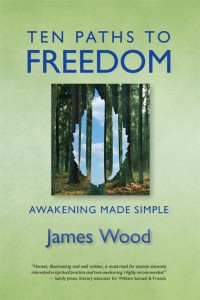
Essential reading for anyone interested in spiritual freedom!
James Wood’s book, The Path of Awakening has a beautiful redesigned cover and new title: Ten Paths to Freedom: Awakening Made Simple. This is one of the most helpful, direct and honest books I have ever read – I learn something new every time I pick it up!
Straight talk from Vernon Howard
“What is there to be concerned about? There’s nothing to be concerned about because there’s no one to be concerned over.”
Ritual of Dependence
“We’re not really dependent on anyone or anything. We’re engaging in a ritual of dependence and making our happiness depend on various relations.
Happiness is inherent in the self position or in our real condition of life. When we begin to notice this, this is the beginning of renunciation. This is the beginning of the expression of true understanding. It doesn’t dissociate us from relations, it simply associates us with a higher principle.
If we depend on relations for this feeling of happiness, that feeling will always be corrupted, threatened and so forth, and will always be associated with the mechanism of dependence. And likewise we’ll always be moved to get independent because we don’t like the feeling that happiness is dependent on someone else, something else, some condition, some object, some circumstance. So we don’t really settle, even in these dependencies. We rebel against them, even. Therefore we become dissociated in relations that we depend on. We corrupt our own happiness in a circumstance in which we do have the option to be happy.
We make our happiness depend on relations and therefore are always suffering in the context of relationship – suffering dependence, manufacturing independence, corrupting relationships, going from object to object, relationship to relationship – struggling all our lives in a circumstance in which we ritually make happiness depend on relationships. And then also struggle with that very fact, resist that very ritual…
Being dependent on relations and conditions, you only feel free to magnify that happiness under certain conditions. So people feel a kind of modest state of well-being, or pleasure, at best, in the ordinary moments of existence. But it’s really clouded over by doubt and dis-ease, unhappiness, threat, fear, anxiety, physical, emotional, mental reactivity and all the rest of it.
It’s only in the million dollar moments – great occasions, great successes, great meetings, great newness and so forth – that you give yourself the liberality to fully feel happy, to be expanded, to be magnified without containment, without limitation, without contraction. These moments pass and the rest of your life is spent seeking a similar moment.
Wisdom is to observe the mechanics of that whole affair: of, basically, unhappiness, in which happiness is an occasional incident within the framework of ritualized relatedness. And to observe the mechanics, and to understand them and to be able to penetrate them to the point of understanding their law, their source condition, is the essence of the beginnings of the spiritual process.
Find the virtue in the self position, prior to a ritualized dependency. This is the beginning of the spiritual process. Until it begins there isn’t any spiritual process, you see.”
-excerpts from the talk Ritual of Sorrow, by Adi Da, 1983
The root sign of egoity
“Fear is the primal sign of self-contraction, the root sign of egoity… All clinging to objects of any kind intensifies first your anxiety and then your fear. Fear is the first artifact of your egoity.”
Doubting our believing
“Certainty is above both believing and doubting, and is attained
by doubting our believing.”
–Vernon Howard, Cosmic Command # 2210

“Wanting to end anxiety is its ever-renewing cause”
“Fear is the raw feeling generated by the ego’s struggle to stave off oblivion. To awaken, your awareness must penetrate to the deepest levels of your fear, to your core, and disidentify from all selfing.
As you meditate into your core emotions, they become more empty, vulnerable, and obscure. Emptier states reflect energy liberated by profound unknowing, the most raw or “naked” of which is the pure, undiluted fear of death, or terror. People want to be liberated from this core terror and the garden variety anxiety on its surface but proceed in the wrong way by avoiding it. Paradoxically, wanting to end anxiety is its ever-renewing cause. Seeing anxiety for what it is without trying to get rid of it ends it. Try to be with it fully without grasping or avoidance. Stay with it. Feel it so clearly and profoundly that it dissolves into Formlessness.
Terror defines selfing: a feeling of existence we assume is real, similar to a constant stomach cramp whose cause we never question because it has always been there. We try to get rid of it by resisting it, but this strengthens it and keeps it going because it is caused by resistance. We think that we have to resist fear to get rid of it, but instead we must accept it. Resistance strengthens it, and radical acceptance destroys it. To find Freedom, you must investigate the terror in your experience fully, accepting what you find there all the way down to the root.”
 -James Wood, Ten Paths to Freedom

Adi Da, Trust
“Fear is only the reflection of the holding on”
“Fear is only our reading…the mood reflected in our contraction, our recoil from infinity, our attempts to survive, our narcissism. If instead of holding on – to mind and emotion and body and relations and the world itself – we release it all, there is no fear whatsoever.
Fear is only the reflection of the holding on.”
–Adi Da, The Religion of the Whole Body, 1977
Who am I?
“You will know who you are when your memory
no longer describes you.”
–Vernon Howard 1500 Ways to Escape the Human Jungle # 1354

The Primary Components, by Franklin Merrell Wolff
The Primary Components:
- Cultivate interest in that which is most universal and least affected by the wearing of time.
- Cultivate a feeling and practice of brotherhood in the most universal sense possible.
- Subordinate personal self-interest to impersonal and general interests.
- Cultivate detachment.
- Lay the primary emphasis upon integrating principles rather than upon the differentia of things
“It is attachment that destroys all love”
“Drop the idea that attachment and love are one thing.
They are enemies. It is attachment that destroys all love.
If you feed, if you nourish attachment, love will be destroyed;
if you feed and nourish love, attachment will fall away by itself.
They are not one; they are two separate entities, and antagonistic to each other.”
– Osho
“The heart says only one thing…”
“Believing that what you want equals what’s best for you is a dead end. It makes the mind stiff, inflexible, caught in a picture of reality rather than open to the wisdom of the way of it…
The heart doesn’t move, it just waits. You don’t have to listen to it, but until you do you’re going to hurt. And the heart says only one thing: What Is, is.”
– Byron Katie, A Thousand Names for Joy

Love
“Love demands more than we can do on our own. Love makes us surrender. More than a feeling, love is the very basis of all that is and the most sacred bond that two human beings can share. Love is the safest and scariest place to be. It erodes our weaknesses and our strengths, turning them into each other.”

♥ Happy Valentine’s Day! ♥
Contradictions a Creative Doorway, by Osho
“When the mind becomes inoperable, that is the moment when the heart starts functioning… when the mind closes up shop, immediately the doors of your heart start opening.” -Osho
“You need not become convinced of anything except that you are suffering a contracted state of existence.”
Adi Da Samraj:
“You must trust the process of your own life, whether it is to go mad, to become ill, to work, to succeed, or to die. Be free of fear. Surrender to the Person of God, the actual Living God. Trust the Divine altogether. Give yourself up emotionally to God. Do it to the point that the physically based fear of death vanishes on the basis of trust alone…
Allow life to be the theatre of God, in which what seems to be appropriate and necessary in your case will be accomplished spontaneously. Allow all of life to be Gods business. Whatever arises, high or low, such a life will simply be surrendering to the point of happiness, giving up to God completely…
You do not really need to know all the technicalities of yoga and the cosmic subtleties of the higher planes of the phenomenal worlds. You need not know anything. You need not become convinced of anything except that you are suffering a contracted state of existence. Feel the force of that contraction, its emotional force, its physical force. Feel the quality of contraction and realize that it is your own action. Realize that you can exist in a totally different condition merely by recognizing your own separative activity and transcending it in each moment.”
Osho, on Love
Why is it easy to Love my work but not a human being?
Osho : ”It is easy to be a sculptor because you are working with lifeless objects. You can create beautiful statues but those statues are dead. You cannot relate with them, you are alive. There is no dialogue possible between life and death.
You can appreciate; you can enjoy; it is your creation. You can feel fulfilled — whatever you wanted, you succeeded in doing it. But remember one thing: on the other side, there is no one. You are alone.
Because of this situation, there are people who can love their dogs, who can love their gardens, who can love their cars, who can love anything in the world except man. Because man means you are not alone, the other is there. It is a dialogue. With a statue, it is a monologue. The statue is not going to say anything, is not going to criticize you, is not going to possess you. You possess the statue; you can sell it in the market. But that you cannot do with a human being. That is the problem.
When you start relating with human beings, you have to take into consideration that they are not things, they are consciousnesses. You cannot dominate them…although almost everybody is trying to do that, and spoiling their whole life. The moment you try to dominate a human being, you are creating an enemy, because that human being also wants to dominate. You may call it love, you may call it friendship, but behind the curtain of friendship and love and brotherhood there is a deep will to power. You want to dominate; you don’t want to be dominated.
With human beings, you will be in constant conflict. The closer you are, the more the conflict will hurt you. There are thousands of people who have been so wounded by human relationship that they have dropped out of all human love, friendship. They have turned towards things. It is easier: the other party is always willing, whatsoever you want to do.
You are an artist, you sculpt. But have you ever thought about what you are doing? You are cutting chunks of the marble — that you cannot do to a human being, but people are doing that to human beings too. Parents are cutting their children’s wings, their freedom, their individuality. Lovers are cutting each other continuously.
To be in love with a human being is not an easy affair. The love affair is the most difficult affair in the world for the simple reason that two consciousnesses, two alive beings, cannot tolerate any kind of slavery.
To love a human being is one of the most difficult things in the world because the moment you start showing your love, the other starts going on a power trip. He knows you are dependent on him or on her. You can be enslaved psychologically and spiritually and nobody wants to be a slave. But all your human relationships turn into slavery.
No statue will make you a slave. On the contrary, the statue makes you a master craftsman, it makes you a creator, an artist. There is no conflict. The real test for love is with human beings.
A man is really intelligent if he can make a human relationship work smoothly. It needs great insight. Creating a statue or making a beautiful painting is one thing — those paints won’t say, “I don’t want to be put on this corner of the canvas, I simply refuse!” Wherever you want it, the paint is available. But it is not so easy with human beings.
Every human being has a birthright not to be dominated by anyone — but also a birth duty not to try to dominate anyone. And only then, friendship can flower.
Love needs a clarity of vision. Love needs a cleaning of all kinds of ugly things which are in your mind: jealousy, anger, the desire to dominate.
Love is a new phenomenon that has arisen with human consciousness. You will have to learn it.
Creating beautiful paintings, poetries, sculpture, music, dances — that is all in your hands. But when you come into contact with a human being, you have to understand that on the other side is the same kind of consciousness. You have to give respect and dignity to the person you love. This is the reason why you cannot relate with human beings.
Forget about human beings and love — you simply meditate. That will release in you the insight, the vision, the clarity, and the energy to share.
Love is another name of sharing your abundant energy. You have too much, you are burdened with it. You would like to share it with people you like. Your love — what you call love — is not a sharing, it is a snatching.
You will have to change the meaning of love. It is not something that you are trying to get from the other. And this has been the whole history of love — everybody is trying to get it from the other, as much as possible. Both are trying to get, and naturally, nobody is getting anything. Love is not something to get. Love is something to give. But you can give only when you have it. Do you have love in you? Have you ever asked this question? Sitting silently, have you ever observed? Do you have any love energy to give?
You don’t have; neither has anybody else. Then you get caught in a love relationship. Both are pretenders, pretending that they are going to give you the very paradise. Both are trying to convince each other that “Once you get married to me, a thousand Arabian nights will be forgotten — our nights, our days will all be golden.”
But you don’t know that you don’t have anything to give. All these things you are saying just to get. And the other is doing the same. Once you are married, then there is going to be trouble because both will be waiting for a thousand Arabian nights and not even an Indian night is happening! Then there is an anger, a rage which slowly, slowly becomes poisonous.
Love turning into hate is a very simple phenomenon, because everyone feels betrayed. You show one face at the beach, in the movie hall, on the dance floor. It is perfectly okay for half an hour or one hour sitting on the beach, holding each other’s hands, dreaming about the beautiful life that is ahead of you. But once you are married, all that you have been expecting, dreaming, will start evaporating.
Meditate. Become more and more silent, quiet, calm. Let a serenity arise in you. That will help you in a thousand and one ways…not only in love, it will also help you to create better sculpture. Because a man who cannot love human beings — how can he create? What can he create? A loveless heart cannot be authentically creative. He can imitate, but he cannot create.All creation is out of love, understanding, silence.
Excerpted from Sermons in Stones/Courtesy Osho International Foundation/
What is meditation?
True Meditation by Adyashanti
True meditation has no direction, goals, or method. All methods aim at achieving a certain state of mind. All states are limited, impermanent and conditioned. Fascination with states leads only to bondage and dependency. True meditation is abidance as primordial consciousness.
True meditation appears in consciousness spontaneously when awareness is not fixated on objects of perception. When you first start to meditate, you notice that awareness is always focused on some object: on thoughts, bodily sensations, emotions, memories, sounds, etc. This is because the mind is conditioned to focus and contract upon objects. Then the mind compulsively interprets what it is aware of (the object) in a mechanical and distorted way. It begins to draw conclusions and make assumptions according to past conditioning.
In true meditation all objects are left to their natural functioning. This means that no effort should be made to manipulate or suppress any object of awareness. In true meditation the emphasis is on being awareness; not on being aware of objects, but on resting as primordial awareness itself. Primordial awareness (consciousness) is the source in which all objects arise and subside.
As you gently relax into awareness, into listening, the mind’s compulsive contraction around objects will fade. Silence of being will come more clearly into consciousness as a welcoming to rest and abide. An attitude of open receptivity, free of any goal or anticipation, will facilitate the presence of silence and stillness to be revealed as your natural condition.
Silence and stillness are not states and therefore cannot be produced or created. Silence is the non-state in which all states arise and subside. Silence, stillness and awareness are not states and can never be perceived in their totality as objects. Silence is itself the eternal witness without form or attributes.
As you rest more profoundly as the witness, all objects take on their natural functionality, and awareness becomes free of the mind’s compulsive contractions and identifications. It returns to its natural non-state of Presence.
The simple yet profound question “Who Am I?” can then reveal one’s self not to be the endless tyranny of the ego-personality, but objectless Freedom of Being — Primordial Consciousness in which all states and all objects come and go as manifestations of the Eternal Unborn Self that YOU ARE.
© 1999 Adyashanti. All rights reserved.
|
Inner Power for Today, by Vernon Howard
The experiment, Franklin Merrell-Wolff
The following is an excerpt from Franklin Merrell-Wolff‘s record of Transformation in the volume Experience and Philosophy. Franklin Merrell-Wolff studied for approximately 25 years before he attained Realization, in 1936. For me, his writing from the time of his Transition is extremely powerful, intellectually challenging and compassionate. It has helped me very, very much. Today, I feel inspired by this passage:
“Again and again I found the statement that, if a man would attain the transcendent realization, he must renounce all, and not merely part, of what he personally is. I did not find this an easy step to consummate. For years I resisted it, offering part of myself, yet holding back a certain reserve. During all this time, I realized only imperfect and unsatisfactory results, and often regretted the experiment. But it was not long before I found that I had gone too far to turn back. I had realized enough to render forever barren the old pastures, and yet not enough to know either peace or satisfaction. For some years, I rested in this position of indecision, without achieving much visible progress. Yet meanwhile, as time rolled on, progressive exhaustion of the world-desire developed, while concomitantly there grew a greater willingness to abandon all that had been reserved and so complete the experiment.”
– Franklin Merrell-Wolff. from “A Mystical Unfoldment” in Experience and Philosophy. 1994. p. 253
Diligence
From The Way of the Bodhisattva by Shantideva
Chapter 7:
2
Diligence means joy in virtuous ways.
Its contraries have been defined as laziness,
An inclination for unwholesomeness,
Defeatism and self-contempt.
3
A taste for idle pleasure
And a craving for repose and sleep,
No qualms about the sorrows of samsara:
Laziness indeed is born of these.
“Too busy is only speech. Only a lazy mind says “I have no time to practice.” When you wake up, if you can practice even for ten minutes, no problem. But if you say, “I am busy, I cannot do that,” that’s lazy mind. If someone says to you, “If you don’t do one hundred and eight bows tomorrow, I will kill you,” then tomorrow morning you will do one hundred and eight bows.”
–Zen Master Seung Sahn. One Person’s Energy Helps All People 1 March 1989
“The only way to obtain the supreme Value is…”
“Ingrained in most people is the idea that value is obtained by getting and having; but the only way to attain the supreme Value is through giving and letting go.”
–James Wood

 Svaha
Svaha 