Ending Suffering

“I think some ideas or notions have crept into Buddhist thinking that it’s going to take a long time to wake up. That’s not necessarily the case. I don’t recommend thinking that with any seriousness, any belief or attachment. I’m not a Buddhist per se, but what I’m here to represent is that awakening is possible for anyone who really wants it.

I think the “really wants it” is a big part. So I’m here to help. But in the meantime, you can have a better life, a more functional life.

When I work with people, if I’m doing a workshop, more formal than a talk, more intensive, I’ll make sure that people understand that this work is consecrated to awakening. As long as you understand that, you won’t think it’s a bait-and-switch where maybe you got into it for personal improvement, and somewhere along the line you realize that the self that you’re trying to improve is going to be gone.”

– James Wood, Ending Suffering


“Humility is getting yourself out of the way”

“Humility is getting yourself out of the way, surrender, like a prostration, letting that Greater Power, Force, Truth, whatever — take you over, until there’s no you, there’s just it. And then it just is.

It strengthens, it endures, it’s powerful — but not over anything. It’s seeing the Divine. And it has its own way of doing things.

There’s no way that the intellect is going to understand that. As soon as the intellect says, “Oh, I’ve got this figured out,” it’s going to do something else.”

-James Wood, Importance of Body

photo (6)

“The mind wants to tell you that you are something that needs to be held onto”

“It’s like your whole life you’re clinging to the side of a cliff, hanging over an abyss, and you’re afraid of falling, of letting go. Not only is there no way to know what that is when that letting go happens ― a complete letting go into awakening itself ― there is no way to know what in some sense awaits you. It awaits Itself. What you’re letting go is “you.”

But let me tell you: when you let go, it’s like you’re suspended about one nanometer above solid rock the entire time. And it’s even more solid ― less risky ― than that. But the mind wants to tell you that you are something that needs to be held onto. And when you let go, the sense of self, just like the politician, is still there, you’ve just voted him out of office. It’s no longer a problem.”

– James Wood, Sanity

Compassionate intervention

“Compassion will just reach in there and break whatever is possessing you. And if there’s an attachment to the pattern, it may be hard to grasp that it’s there to help you. It may seem like an enemy, and you will fight it. There’s a certain kind of force to the intervention, the way a surgeon might perform an emergency appendectomy with a spoon if necessary.”

– James Wood, Importance of Body

20121103_115128

Compassion fuels practice

James Wood on compassion:


“How long do I practice before I wake up? It’s like digging to China. How do you know when you get to China? You see daylight, stick your head out, and there are Chinese people around.

Or like a big stack of dishes. If you’ve ever been to a cafeteria, they have a cart that has a cylinder full of plates that is spring-loaded from the bottom. When you take the top plate off, the next one rises to the surface. How do you know when you’ve taken the last plate?

It’s a good question, and the best advice I could give is that the fastest way through the stack is to focus on the one you’re doing now. As soon as you stop to say, “Gee, I wonder how big the stack is?”, you’re not doing it, and it’s just sitting there.

I think that’s part of why compassion is so powerful. Like, how many doors would you break through to get to your child who is trapped in a burning building?

Or even better: How many doors would you break through to get out of the burning building so that you could then see where your child is and go and rescue your child? That’s a good one. Then it’s not just for you, and yet it is for you. Can you feel into how much power it might give you?

Imagine this long hallway of doors. You know the building is burning down and you want to get out. But if you knew somehow that you had to get out so that you could then survey the building to find out where your child was to rescue him — to me it feels like it turbo-charges the whole thing.

Like I have to do it, and I have to do it for myself, but I’m doing it so I can do it for someone else. That’s what I’m talking about.”

– James Wood, Importance of Body

“If you really want to contribute to world peace, find the cause of your own anger and eliminate it.”

tenpathstofreedom-200x300“Recognition of Truth ends violence because there is no conflict in it. Violence and war are at the root caused by resistance to Reality. The world exists as a conflict between Reality and what the mind thinks Reality should be. If you can see that you are actively fighting Reality, you can stop doing it. That is the beginning of world peace. Begin by noticing how your anger is caused by resistance to what is, creating an unpleasant feeling ranging from mild irritation to full-blown fury.


Violence begins in you as turbulent emotions such as annoyance, irritation, frustration, and anger that are severe forms of resistance. Annoyance, irritation and frustration are low-grade forms of anger, and rage is violent, explosive anger. These feelings often lead to some kind of destructive action, such as physical violence against a person or angry speech. All violent actions, even words or harsh movements, are harmful to others. Notice that any form of discordant feeling in you is a form of violence. Notice if your movements become angular and sudden. If so, violence is brewing in you. Observe that, when you get angry, you are contributing to violent energy on the planet. If you really want to contribute to world peace, find the cause of your own anger and eliminate it. Then you can be a cause of peace.”

– James Wood, Ten Paths to Freedom

Witnessing suffering

“When I witness suffering, I’m simultaneously seeing myself — at least in the sense of body — as a fleshy contraption that’s vulnerable. There’s real humility in that, I find. There’s really no escaping it.”

James Wood, Importance of Body


20120313_125604

James Wood on Compassion

“When Whitman says “The armies of those I love engirth me and I engirth them,” he’s talking about compassion. Compassion is in a sense seeing the Divine in another and simultaneously within oneself. And it holds me here — this earth, this realm, whatever you want to call it — because I love. I deeply, deeply love human beings — all beings, but humans suffer — not only suffer but cause suffering in a way that animals don’t, plants don’t. It’s the mind. It’s our ability to conceptualize. Of course, whose ability to conceptualize, right?

Compassion is self-serving. It’s very clear. But it’s self-serving for the sake of others. It’s not the same as selfishness. When we say “self-serving,” that usually means egotism, selfishness, and so on. But there’s an element of compassion that’s a force. That’s not what it actually is, but it manifests as a force. That’s part of its manifestation. It’s a force that holds self together, actually. But it does so for the sake of others, and only for the sake of others.

But paradoxically, when it’s done for the sake of others, it — I almost want to say it makes self impenetrable — like it’s fortified with Wisdom, Truth. Because it’s completely and utterly not for itself. So if ego is an attachment to self, and that goes away, that disappears (in awakening), then what happens is Truth takes over.”

-James Wood, from the talk Importance of Body


How to win an argument

“The best way to win an argument is

not to have one.”

– James Wood

20130508_193830

True prayer

 “Prayer is the surrender of judgment about what should happen, letting Truth run your life. It is rightly understood as a form of meditation. The most common form of prayer consists in asking God for something for yourself, or petitionary prayer. This is not true prayer. Can you really know that you will be better off getting what you want? Can you really know what is best for you or anyone else? Since God’s will is what is happening at any given moment, praying for a specific outcome implies a basic distrust of God’s will. Not trusting God’s will is a barrier to Liberation. If you really knew what was best for you, wouldn’t you have made it by now? Wouldn’t you be truly happy? True prayer implies surrender to God’s will, to Reality.

What else is there?”

-from Ten Paths to Freedom by James Wood

The only way to end global suffering…

“The only way to end global suffering is through the awakening of individuals”

James Wood


The snowball of judgment and how to stop it, by James Wood

THE “SNOWBALL” OF JUDGMENT AND HOW TO STOP IT 

“Judgments snowball until the mass of mind-material overwhelms you. It is important to know how to break the cycle. Notice if you judge, and then notice if you judge yourself for judging, and then notice if you judge yourself for judging yourself for judging, and so on. If the tangled mess is too complex and hard to follow, just notice the feeling of all those judgments until you can discern patterns and notice those. The better you get at noticing what you are thinking and feeling in the moment, the quieter your mind will become, and the more you will be able to notice individual thoughts before they can spin out of control. You must see yourself exactly as you are in the moment without flinching or turning away, without apology or rationalization, without creating a ” me” out of it—as in I’m no good because I’m angry and I’m angry because I’m no good. That is how you get wound up tight. That generates more anger. You are afraid of dissolving, so you contract in fear, judging yourself to defend against dissolution. Ecstasy is terrifying for the ego to taste, much less BE.

Your mind will try to lash out and get you involved in its ugliness by getting you to judge yourself for judging. Remember, you are not your mind. If your mind lashes out, notice it but recognize that you are the witness while your mind is the perpetrator. Let it show you what you are doing unconsciously, because on some level you are imbuing your mind with a sense of self that keeps it going. The mind tries to get you to identify with it. You are not your mind, but you are responsible for its behavior, in the same way that you are not a vicious dog, but if you own a vicious dog, you are responsible for watching it and keeping it from attacking others or responding appropriately if it does attack someone. As you go through your day, notice what the mind is doing. Keep it on a leash. Discipline it by developing discriminating awareness. Often, the mind lies in wait for you to let your guard down. If your mind suddenly rages out of control, just notice it. Like a vicious dog, it’s not who you are. It may feel like you, but it’s not. You must witness it impersonally and see it for what it is, without judgment. This keeps you from beating yourself up when you see what it’s up to.

Judgment obscures your true nature and keeps you from having permanent peace and satisfaction, like a pond that is clogged with trash. If you unclog the pond and tap into life without judgment, you will taste the sweetness of Freedom like spring water from a pristine well, the Truth you have been looking for as long as you can remember.”

  -from Ten Paths to Freedom by James Wood

Embracing Uncertainty, by James Wood

Embracing Uncertainty

“To be in the world but not of it, you must be able to embrace uncertainty and chaos. You must give up trying to know things with the mind, as if mental certainty—something you will never get—will deliver you from life’s inherent uncertainty. You cannot ever know things with complete certainty. An awakened person doesn’t know things with absolute certainty, as if thought could deliver Truth. She is absolute certainty, regardless of any thoughts that may appear. An awakened person enjoys just being with what is and letting the future take care of itself. Wanting certainty in life is like skipping to the end of a novel to find out what happens, or wanting to learn the end of a movie without watching it—only in life, the story never ends, and you miss all the good parts. It blocks your joy of the Now and makes life feel incomplete, like you’re missing something.

Chaos is constant. You cannot predict when things will go wrong. “Wrong” just means chaotic or unexpectedly out of control. Chaotic circumstances are not ultimately wrong, just messy. Life is never going to get more orderly or certain than it already is. If you create order in one place, chaos erupts elsewhere. If you wait for certainty, it will never happen. The awakened life is not completely certain, as the mind might have it. In a way, it is completely uncertain, involving total trust. It is Wisdom. In that sense, it is complete and hence completely uncertain, but only on the level of Being. On the level of the mind, it is out of control. The mind cannot grasp it, cannot comprehend it. Knowledge is necessary for getting by in the world, but it cannot give you certainty. It is the uncertainty and chaos of life that makes it spontaneous and fun. You have to let go of the mind to get there.”

   – from Ten Paths to Freedom by James Wood

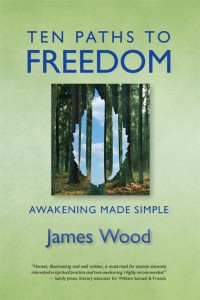
Ten Paths to Freedom: Awakening Made Simple


Essential reading for anyone interested in spiritual freedom!

James Wood’s book, The Path of Awakening has a beautiful redesigned cover and new title: Ten Paths to Freedom: Awakening Made SimpleThis is one of the most helpful, direct and honest books I have ever read – I learn something new every time I pick it up!

“Wanting to end anxiety is its ever-renewing cause”

“Fear is the raw feeling generated by the ego’s struggle to stave off oblivion. To awaken, your awareness must penetrate to the deepest levels of your fear, to your core, and disidentify from all selfing.

As you meditate into your core emotions, they become more empty, vulnerable, and obscure. Emptier states reflect energy liberated by profound unknowing, the most raw or “naked” of which is the pure, undiluted fear of death, or terror. People want to be liberated from this core terror and the garden variety anxiety on its surface but proceed in the wrong way by avoiding it. Paradoxically, wanting to end anxiety is its ever-renewing cause. Seeing anxiety for what it is without trying to get rid of it ends it. Try to be with it fully without grasping or avoidance. Stay with it. Feel it so clearly and profoundly that it dissolves into Formlessness.

Terror defines selfing: a feeling of existence we assume is real, similar to a constant stomach cramp whose cause we never question because it has always been there. We try to get rid of it by resisting it, but this strengthens it and keeps it going because it is caused by resistance. We think that we have to resist fear to get rid of it, but instead we must accept it. Resistance strengthens it, and radical acceptance destroys it. To find Freedom, you must investigate the terror in your experience fully, accepting what you find there all the way down to the root.”

    -James Wood, Ten Paths to Freedom

Love

“Love demands more than we can do on our own. Love makes us surrender. More than a feeling, love is the very basis of all that is and the most sacred bond that two human beings can share. Love is the safest and scariest place to be. It erodes our weaknesses and our strengths, turning them into each other.”

– James Wood

♥  Happy Valentine’s Day!  ♥

“The only way to obtain the supreme Value is…”

“Ingrained in most people is the idea that value is obtained by getting and having; but the only way to attain the supreme Value is through giving and letting go.”    

James Wood


Confusion

“The mind resists perceived injustice because it wants to make things better. It judges some things as insufficient, so it strains against them in order to improve them. This doesn’t work. This just adds to the confusion and misery in your life.”

 –James Wood

More -isms

“Nihilism is the rejection of everything but rejection. It has no stance – except the stance of having no stance.

Being for or against ideas is just another idea. We are free when we no longer derive a sense of self from being for or against anything. When you have no views, even the view of having no views, you are truly free.

Both attachment and rejection mire you more deeply in sleep.

Find what is false in yourself. If you do this deeply enough, you will wake yourself up from this nightmare of conformity and nonconformity and find Something Else. This is not a religion.

Atheists have a god and that is the god of having no god. Who would you be without any positions or beliefs at all?”

James Wood Stelzenmuller. The Path of Awakening (2007) p.265-266


Reflections on meeting the Teacher

I had been practicing Zen for a few years. Many of the folks I sat zazen with had been at it for decades and thinking about that terrified me.

When I heard from a friend that James was ‘awake’ – as in, enlightened, free of dukkha – I had to check it out. Could it be? Someone, living, not far away, but across town, in Tucson, Arizona, had done what it seemed so impossible to do? I was all doubt, skepticism and Zen-snobbery.

I had to meet him. I had questions.

The rest is history, you could say. Things sped up.

Shortly after I started working with James, an answer to the Mu koan appeared. I had been chewing on that one, and giving ridiculous attempts at answers to my Zen teacher, for about 3 years. I started to see more translation of in-zazen-realizations into the rest of life.

For me, teachers of spiritual awakening are access points, way-pointers, nudging me toward what’s possible. James’ perspective and friendship help keep me going in the right direction, like the breadcrumbs that lead out of the deep dark forest.

Here is a beautiful piece in which Richard Moss writes about meeting Franklin Merrell-Wolff.

Joel S. Goldsmith on the function of the spiritual master:

In some religious teachings, there are those known as masters, just as in ancient days Jesus was called Master. A master is one who has achieved some measure of spiritual freedom, which means some measure of nonattachment to the things and thoughts of the world. People often get the idea, however, that the function of a master is to take over another’s mind and life and to govern and manage them for that person, but a master is one to whom a person can go and through whose help and co-operation he can be lifted up into a state of spiritual consciousness and discernment where he himself realizes the Master in his own consciousness. The Master is not a man: the Master is a state of unfolded and developed consciousness.

– Joel S. Goldsmith. The World is New (1997).

What is social activism?


James Wood
:

Social activism is a form of love in action. If you base your activism in a value judgment – e.g., that the world is “messed up” – you will only create more pain in the world.

As far as social activism is concerned, just liberate yourself and trust what happens. Human rights arise from the true heart of all morality, the conscious human being. The more awake you are in the world, the more just, righteous, and fair your actions are. Anger does not produce positive social change. Liberation does. Anger just makes you harder, meaner and more afraid. Negativity in any form is not necessary for vigorous action that, in its own way, subverts an unjust social order.

The Path of Awakening (2007) p. 110

Vernon Howard:

If you straighten yourself out, if you are no longer putting out hostility or deception, then you are putting out something that is helpful, therefore that is the only thing you can do to help society… Your anger is the cause of war.

-The Esoteric Path to a New Life MP3 CD, “A revealing interview with Vernon Howard”

Byron Katie:

Just as we use stress and fear to motivate ourselves to make money, we often rely on anger and frustration to move us to social activism. If I want to act sanely and effectively while I clean up the earth’s environment, let me begin by cleaning up my own environment. All the trash and pollution in my thinking- let me clean that up, by meeting it with love and understanding. Then my action can become truly effective. It takes just one person to help the planet. That one is you.

-Loving What Is (2003) p. 107-108 and here is an additional excerpt on activism from A Thousand Names for Joy (2007)

Franklin Merrell-Wolff:

This view is not merely altruism in the usual meaning of the word, for in the latter sense, altruism involves a difference between one’s own self and others… I Recognize more in every man’s Recognition. I am delayed by every man’s failure. Every new facet opened by another individual man breaking through is a new facet awakened in My understanding. Thus, from this standpoint, the duality of selfishness and altruism is destroyed.

-Experience and Philosophy (1994) p.91


Description or Value Judgment?

James Wood:

“A description and a value judgment are not the same thing. If I see a cup on the table, the statement “The cup is on the table,” is an accurate description of my experience, a basic truth. If I say, “The cup shouldn’t be on the table. It should be in the dishwasher,” I am making a value judgment, because I am implying that my experience should be other than it is now or would be better if something else were happening. This is also true if I say “The cup is ugly,” “You’re an idiot for owning such an ugly cup,” or “I hate myself for being so careless as to leave a cup out on the table again.” A value judgment implies that something is wrong or bad about my experience. In this case, the badness or wrongness – the “shouldn’t be-ness” – can be attributed to the cup, to its owner, or to myself. You can judge anything or anyone for any reason. Descriptions are useful because they convey information about the world. Value judgments are confusing because they conflict with Reality. Notice the difference.”

James Wood, The Path of Awakening (2007) p. 19

Problems?

Ultimately, there is no such thing as a problem. The mind generates the appearance of problems to maintain a sense of self. Practically speaking, a problem is a painful situation. The only way out of a painful situation is to take appropriate action. This does not require value judgment and stress. Conscious action dissolves judgment and relieves stress.

James Wood Stelzenmuller, The Path of Awakening 2007, p.88

Resistance

James Wood:

“The unawakened state is characterized by resistance or this shouldn’t be happening. Suffering is caused by a split between Reality and what you think it should be. When what is happening and what you think should be happening are different, you suffer. To the degree that you energize what you think should be happening in opposition to what is happening, you experience the pain of unconsciousness, like steel plates grinding against each other.

How do you know what should be happening? Look around; it’s happening.

There is nothing you can do about it.

In addition to a should, resistance can also be expressed as a want or a need: this shouldn’t be happening then becomes I want this not to be happening or I need this not to be happening. If what I want to be happening or what I need to be happening is different from what actually is happening, I generate pain and unconsciousness. For example, consider the following statements: “It should be raining.” “I want it to rain.” “I need it to rain.” If it’s not raining, attaching to these thoughts hurts. In the awakened state, I recognize that what should be happening, what I want to be happening, and what I need to be happening are all the same thing.”

–  Ten Paths to Freedom by James Wood


Gratitude

“Practice gratitude for all you have, especially for what serves your growth in consciousness. Take moments throughout the day to reflect on the blessings you have received in life that have led to this point. The practice of gratitude tends to instill humility, a condition that is favorable for awakening. It also leads to joy and faith. If you are grateful for what you have, regardless of how little it may seem, more will be given to you, and you will also be more likely to use what you have for noble purposes.”

-James Wood, Ten Paths to Freedom 

Part Three: truth and Truth

Part One of this 3 part series was a look at the question: Do you suffer? using the First Noble Truth from Buddhism: Life is suffering, or dissatisfaction.  Part Two was an exploration of the question: Can suffering/dissatisfaction end completely?  Part Two and a Half had to be written, and it briefly addressed the idea that the end of suffering = the end of the mind, which is a highly problematic view, in my view.  (For more on that, please see ‘Sanity’ by James Wood.)

I don’t claim to know anything.  I’m happy to debate, respectfully.  What I offer in this blog is the understanding of The Teaching on freedom from suffering that I have arrived at by asking my primary Teacher lots of questions and studying my secondary Teachers.

That brings us to Part Three: truth and Truth.  It is useful to be able to discriminate between relative truth and Absolute Truth.

For example, if someone is thirsty and he asks me for water, I do not say, ‘oh, nah, you’re confused, ‘water’ is just a word.’  Yes, ‘water’ is just a word, in an Absolute sense, but it refers to something in the world of relative experience that can help the person who is thirsty.  I know what ‘water’ refers to.  I don’t know what it ultimately is.

This gets a bit trickier when we talk about ‘spiritual’ stuff.  ‘Truth’ is just a word, but it refers to something that helps.  Awake teachers encourage us to find and express what is true in our relative experience, (are you dissatisfied?) while pointing us to the Absolute Truth of freedom that is beyond what words can capture.

Absolute Truths are statements made from the perspective of awakened (enlightened) consciousness about the nature of Reality – statements like ‘Truth is all there is’ or ‘the world is an illusion’.  Liberated individuals speak like this because they are firmly planted in the awake state, out of the nightmare of dissatisfaction.  Absolute Truths are helpful because they lead us somewhere.  (The map is not the destination.)

True Teachers are able to switch between speaking from the perspective of Absolute Truth (it’s just a dream you’re having) and the perspective of relative truth (are you thirsty? would you like a glass of water?

Absolute Truths are used dishonestly quite often.

What I mean by that is – if I were to use statements of Absolute Truth it would be dishonest because I am not spiritually awake.

[I can say, honestly, that I have a strong intuition and I accept, intellectually, that the end of all dissatisfaction is possible.  I can repeat what True Teachers say or discuss my interpretation of what they say.]

When I am angry, for instance, that is the (relative) truth, in that moment.  It would be dishonest for me to react to the anger with an Absolute Truth like ‘Truth is what I am’ or ugh, ‘This anger is the truth.  I am already free’.

No. For me, anger is an (level of the nightmare) issue, so I employ relative truth.  I find the source of the anger – thoughts about what I want that I’m not getting, usually.

Then, I recall the Teaching – anger is fueled by attachment to ‘what I want’ and then, deeper, attachment to thoughts like ‘I shouldn’t feel angry.  I don’t want to feel angry now or ever again.’

Until judgment of What Is does not drive me, I’m not free and I cannot speak as if I am.

3 Part series summary:

  • It’s useful to notice if you are dissatisfied.
  • Dissatisfaction is unnecessary – it can end it, completely.
  • Absolute Truths are statements made from the perspective of Awakened consciousness and are sometimes mistakenly used to deny what is true in relative experience.

When a seeking mind finds what it seeks, it feels its reward.  This means that if you have a seeking spirit you want to find something other than your present level.  That very right sincere wish will lead you to the recognition of that higher state when it appears and presents itself to you.  Because there is a matching of your wish and the fulfillment of that wish, there is what we commonly call an inspiring feeling.  Just like when you’re thirsty and have a drink of water there’s a certain satisfaction there.  You wanted the water.  you had the water and there is the reward.  However, when you have this experience of feeling good when having met a truth, you also feel that it’s not enough.  Let’s go very carefully into this now because the point is enormous.”

from a talk given 6/22/1988    Vernon Howard’s Higher World – Volume 21, talk 507

The Game of Life: Who’s playing?

“True freedom and the end of suffering is living in such a way as if you had completely chosen whatever you feel or experience at this moment.  This inner alignment with now is the end of suffering.”

Eckhart Tolle

“Life is simple.  Everything happens for you, not to you.  Everything happens at exactly the right moment, neither too soon nor too late.  You don’t have to like it… it’s just easier if you do.”

Byron Katie

“What you truly need may not be what you think you need.”

James Wood

I never made any plans-
the Plan is there
and we can fit in
with joyous ease
and delightful uncertainty.

Shunyata Emanuel Sorenson

I like movies.  A lot.  Have you seen The Game?  It’s way high on my list of favorites.

So, Michael Douglas’ character signs up to play a very mysterious game – there seem to be no rules, no boundaries and no objectives.  Or, he is not told what the point is when he signs up to play.

The Game is different for each player, and the rules change continuously, depending on the player’s responses and reactions.  Once a player has committed to the game, it does not stop… until… well, writing too much about it will spoil the effect for those of you who haven’t seen it   :)

“Awakening is Truth-recognition.  It is not an experience, state, or form of anything you can mentally know.  The path of awakening involves finding false ideas, or lies, and seeing their falseness.  When you see their falseness, you see truth.  To find truth you have to be a detective.  You have to notice that things don’t add up, like a bad alibi.”

James Wood The Path of Awakening (2007) p. 2-3

Who’s playing?   ;)

Working with Dreams, by James Wood

Working with Dreams

“Let your dreams wake you up.  Let them show you patterns hidden beneath the surface of your awareness or illuminate ongoing issues… Let them shock you into a new awareness… On a deep level, we all share the same dreams…

Life is like a dream…The foundation of the dream is a lie of independent existence.  Your dream is the one you are having now, a dream of life and death, parading in an endless cycle.”

-James Wood.  The Path of Awakening (2007)  pp. 219-222

If you haven’t seen Inception yet, you’re in for a treat.  I like movies that help us question reality.  Inception is my new favorite!


Stress

I got interested in this teaching because I was stressed, and distressed.

I appreciated all the comforts, privileges and pleasures I had in my life, but I could never shake the underlying sensation of dissatisfaction.  (I also felt guilty for feeling dissatisfied, because I had the comforts and privileges.)  I tried to talk myself out of the dissatisfaction.  I worked jobs in social services.  Nothing seemed to help.  I have a serious case of The Dreaded Gom-Boo.

Some may say that stress is just a part of life, that it is wise to just accept it and treat the symptoms – with humor, philosophy, religion, alcohol, etc.  For me, ignoring the haunting dissatisfaction (or temporarily covering it up) has never worked.  I want to get to the bottom of it.

When I discovered this teaching, I learned that I do not have to continue living with stress.

I learned that it is extremely important to focus my attention precisely on the sensation of dissatisfaction, not to avoid it.  It was important to get serious about examining it.

I learned that there are people, even people living now, in modern times and situations, who are free of suffering.  And they are not sitting around enjoying their own personal contentment.  Pain continues to arise in others, so they are busy teaching.  It’s like in action movies, when the heroes fall in love – they do not, will not, stop to enjoy the honeymoon.  They have more people to save, more villains to defeat, and they just keep going, hardly missing a beat, in love and fighting the good fight.

This is a great talk, recently posted on James Wood’s website, that addresses the importance of witnessing the stressful self-contraction without judgment.


Who are these teachers of spiritual awakening?

One of the many benefits of getting to know James before he wrote his book and got busy teaching was the time we spent discussing the teachers who influenced him when he was a student.

James has an extensive collection of audio tapes, CDs and literature written by awakened individuals.  In those early days we would spend hours watching videos, listening to talks and reading excerpts from the books.  We talked about the material at length.  At first, I was skeptical of every one of these individuals.  I was fond of the Zen tradition of transmission, in which a teacher receives permission to teach from his or her superior, usually after decades of formal practice.   Most of the teachers James introduced me to had not received formal transmission of any sort.  They spoke on their own authority, using their own terms, about awakening.

Listening to the first borrowed audio talk in my car driving home from James’ house, my skepticism flew out the window.  (As I recall, it was a tape of Bryon Katie leading people through The Work… )  I borrowed more material and couldn’t keep my head out of the books.  All these teachers were saying the same thing, in their own terms, in their own ways!  But the message was the same message, and the same root teaching of Zen – life is suffering and there is a way out.  As Byron Katie says, “you are the cause of your suffering, but only all of it.”  This was great news.

I noticed several things as I learned about these teachers.  I noticed that they do not rely on religious traditions, texts or systems.  They may refer to passages in religious texts or use certain rituals, but they communicate only from the authority of their own personal and direct realization.  They speak spontaneously in response to their immediate surroundings, listeners and life circumstances.  Talks do not have the tone of a planned lecture.  In general, there is not a course of study or step by step plan of attainment.  There may be guidelines or mile-markers that students tend to notice along the way, but the mile-markers are not stages of enlightenment, just the possible results of applying certain practices.

In my studies, I did not hear these teachers say – you are already free,  there is nothing you need to do.  There is no denial that we are suffering anxiety, stress, fear, anger and the whole spectrum of negative emotions.  They say, freedom is our birthright, or natural state, and we cannot do anything search-wise to find it.  True freedom comes by grace, and, we can take steps that develop a stronger psychological/physical/emotional/social vessel that is able to contain and express that natural state.  Practices like meditation and inquiry help me.  I am not spiritually awake, but there is progress that I feel as less density and a relief from the sense of dis-ease.

Access to the work of a variety of persons living and expressing the awakened state grew my hope and determination to keep going.  At first exposure, I felt the light at the end of the tunnel getting brighter and over time I feel my ‘self’ getting lighter.